Artificial intelligence continues to transform digital communication, especially in voice technology. Businesses, content creators, educators, and developers now rely heavily on text-to-speech tools for videos, podcasts, virtual assistants, audiobooks, customer support, and gaming. Among modern AI voice solutions, GPT-SoVITS has gained significant attention for its advanced voice cloning and natural speech generation capabilities. Traditional TTS software, however, remains widely used across industries.
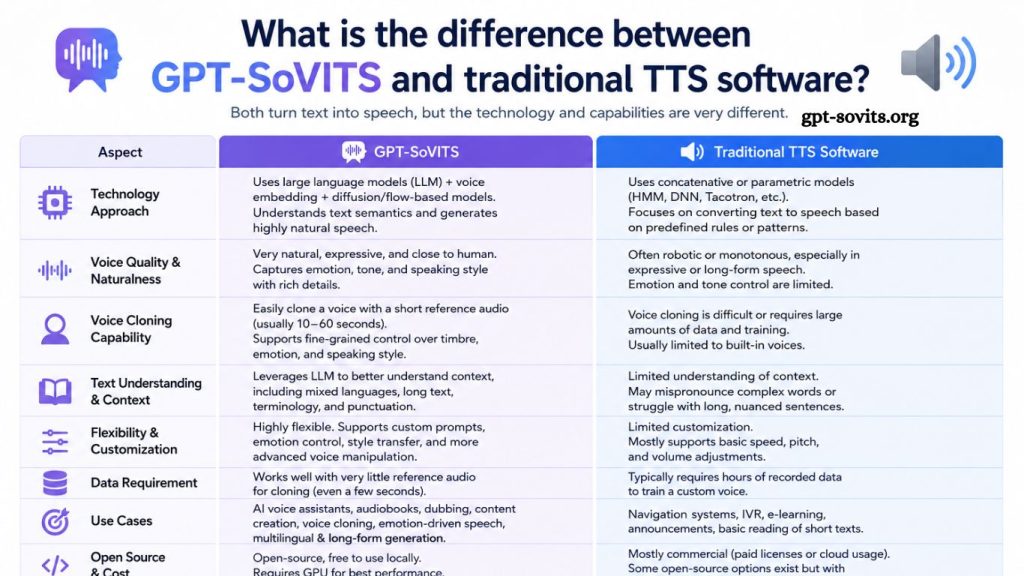
Understanding the difference between GPT-SoVITS and traditional TTS software helps users choose the right solution for their projects. Both technologies convert text into spoken audio, yet they differ greatly in voice quality, flexibility, training methods, emotional expression, and real-world performance.
Understanding Traditional TTS Software
Traditional text-to-speech software converts written text into synthetic speech using pre-recorded voice datasets and rule-based systems. Earlier TTS engines depended on concatenative synthesis, which stitched together small segments of recorded audio to form words and sentences. Modern systems often use neural networks but still follow structured speech-generation pipelines.
Popular traditional TTS platforms include:
- Google Text-to-Speech
- Amazon Polly
- Microsoft Azure TTS
- IBM Watson TTS
These platforms focus on stability, scalability, and commercial integration. Businesses commonly use them for navigation systems, customer service bots, accessibility tools, and automated announcements.
Read More: GPT-SoVITS System Requirements: Complete Setup Guide
Traditional TTS systems generally provide:
- Multiple voice options
- Language support
- Adjustable speed and pitch
- API integration
- Commercial scalability
Despite these advantages, older TTS models often produce robotic or emotionally flat speech. Even advanced neural TTS solutions may struggle with realistic voice cloning and emotional nuance.
What Is GPT-SoVITS?
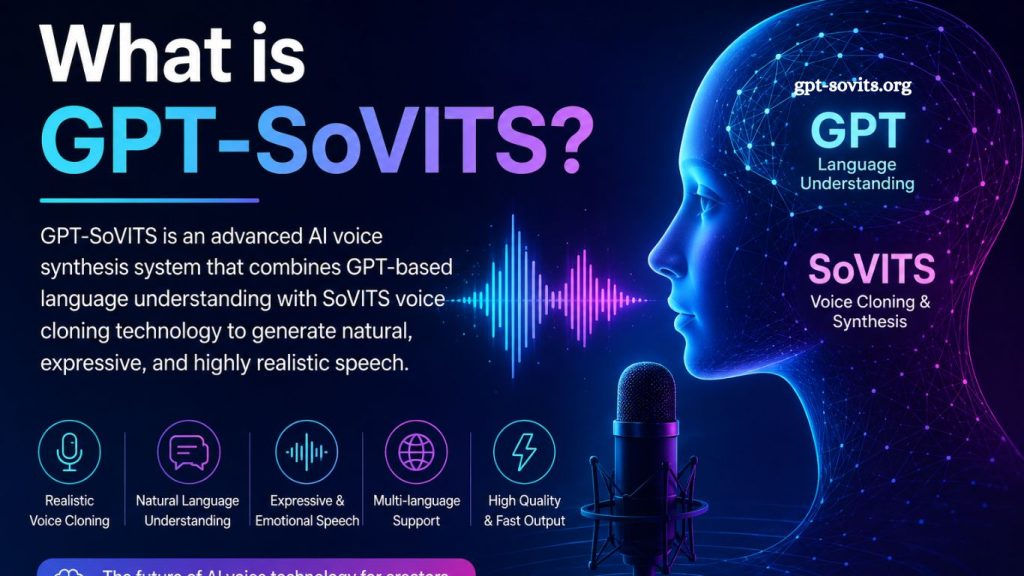
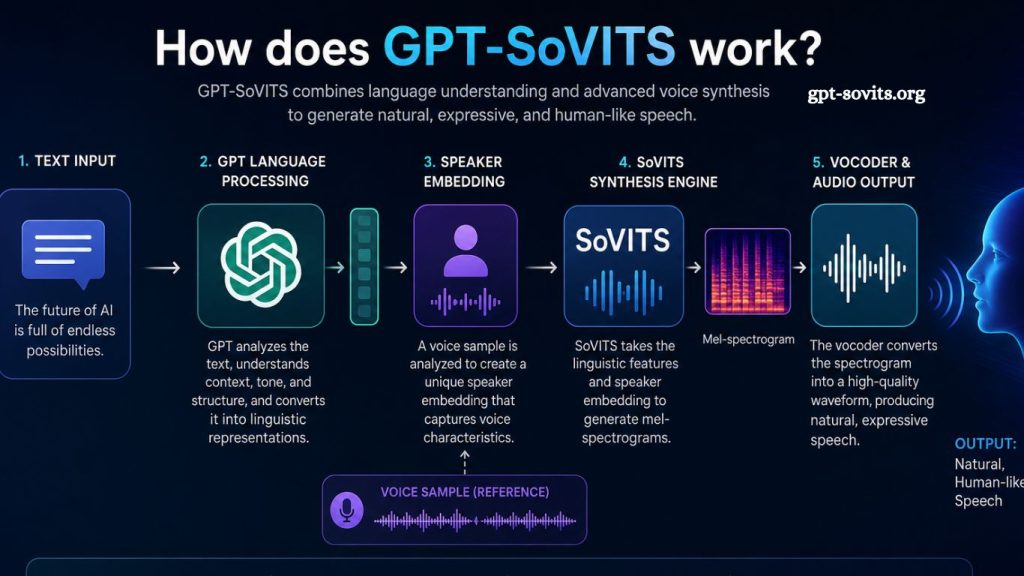
GPT-SoVITS combines GPT-based language modeling with SoVITS voice synthesis technology to create highly realistic AI-generated speech. Unlike conventional TTS engines, GPT-SoVITS can replicate human voices using very short voice samples while preserving natural tone, emotion, rhythm, and pronunciation.
Developers designed GPT-SoVITS primarily for:
- AI voice cloning
- Realistic narration
- Character voice generation
- Multilingual speech synthesis
- Personalized AI assistants
GPT-SoVITS uses deep learning models trained on large voice datasets. Instead of relying only on fixed speech patterns, it analyzes speech characteristics dynamically, allowing more natural expression and human-like delivery.
Many creators prefer GPT-SoVITS because it produces speech that sounds closer to real human conversation rather than machine-generated audio.
Core Difference Between GPT-SoVITS and Traditional TTS Software
Voice Realism
Voice realism represents one of the biggest differences between GPT-SoVITS and traditional TTS software.
Traditional TTS systems often generate clear but mechanical speech. Pronunciation may sound accurate, yet emotional depth and conversational flow usually remain limited.
GPT-SoVITS creates highly natural speech patterns with realistic breathing, tone variation, pauses, and emotional expression. Human listeners frequently struggle to distinguish GPT-SoVITS audio from actual human recordings.
Content creators, filmmakers, and podcasters benefit greatly from this realism because audience engagement increases when voices sound authentic.
Voice Cloning Capabilities
Traditional TTS software typically offers pre-built voices with limited customization options. Creating custom voices often requires extensive recording sessions and expensive enterprise-level training.
GPT-SoVITS dramatically simplifies voice cloning. Users can generate cloned voices from as few as a few seconds to a few minutes of recorded speech. This capability makes GPT-SoVITS extremely attractive for creators who need personalized or character-based voiceovers.
Voice cloning advantages of GPT-SoVITS include:
- Fast voice replication
- High speaker similarity
- Natural emotional delivery
- Multilingual adaptability
- Flexible voice customization
Traditional systems rarely match this level of voice imitation accuracy.
Emotional Expression
Emotion significantly impacts listener engagement. Robotic speech reduces audience connection, especially in storytelling, gaming, and educational content.
Traditional TTS software generally delivers neutral speech patterns. Some premium systems support basic emotions like happiness or sadness, but transitions often sound artificial.
GPT-SoVITS handles emotional variation far more effectively. Speech output can sound excited, calm, serious, dramatic, or conversational, depending on training data and prompts. Emotional flexibility helps creators produce immersive audio experiences.
Gaming studios, animation creators, and audiobook narrators increasingly adopt GPT-SoVITS because emotional delivery enhances realism.
Training Requirements
Training requirements differ greatly between the two technologies.
Traditional TTS custom voice models often demand:
- Large voice datasets
- Professional recording environments
- Hours of speech samples
- High development costs
GPT-SoVITS reduces these barriers substantially. Short audio clips can train effective voice models, making advanced AI voice generation accessible to smaller creators and independent developers.
Lower training requirements also speed up production workflows.
Language Support and Adaptability
Traditional TTS software usually supports many languages through professionally trained models. Large corporations optimize these systems for global business applications.
GPT-SoVITS also supports multilingual speech synthesis, but its flexibility stands out more. Users can often adapt voices across multiple languages while maintaining speaker identity and natural pronunciation.
This adaptability benefits:
- International content creators
- Localization companies
- Multilingual educators
- Global marketing teams
Voice consistency across languages creates a stronger brand identity and user experience.
Speech Naturalness and Flow
Speech flow directly influences perceived audio quality.
Traditional TTS systems sometimes produce awkward pauses, unnatural pacing, or repetitive intonation patterns. Long-form narration can become tiring for listeners.
GPT-SoVITS generates smoother transitions between words and sentences. Speech rhythm feels conversational rather than scripted. Dynamic intonation patterns help maintain listener attention for extended periods.
Audiobook creators especially value this improvement because natural pacing improves listening comfort.
Flexibility for Creative Projects
Creative industries demand flexible voice technology.
Traditional TTS software works well for structured applications like:
- GPS navigation
- Customer support systems
- Accessibility readers
- Automated phone systems
GPT-SoVITS excels in creative environments requiring expressive speech and character identity.
Examples include:
- YouTube narration
- AI influencers
- Film dubbing
- Animated characters
- Virtual streamers
- Interactive storytelling
- Video game dialogue
Creative professionals often choose GPT-SoVITS for its greater artistic freedom.
Cost Differences
Pricing structures vary depending on platform and deployment.
Traditional enterprise TTS services usually charge based on:
- Characters processed
- API requests
- Monthly subscriptions
- Cloud usage
Commercial-grade custom voice creation may cost thousands of dollars.
GPT-SoVITS, especially open-source implementations, can significantly reduce long-term costs. Many developers run models locally to avoid expensive API fees. However, powerful hardware may still become necessary for advanced training and fast generation.
Small businesses and independent creators often view GPT-SoVITS as a more affordable alternative for high-quality voice synthesis.
Hardware and Performance Requirements
Traditional cloud-based TTS solutions require minimal local hardware because processing occurs on remote servers.
GPT-SoVITS models often require more powerful GPUs and higher computational power for training and inference. Running advanced AI voice models locally may be challenging for users with limited technical resources.
Performance considerations include:
- GPU memory
- Processing speed
- Audio rendering time
- Storage requirements
Businesses seeking plug-and-play simplicity may prefer traditional cloud TTS systems, while advanced users often favor the flexibility of GPT-SoVITS.
Accuracy and Pronunciation
Traditional TTS systems generally excel in pronunciation consistency because large corporations spend years refining speech engines.
GPT-SoVITS achieves impressive pronunciation accuracy while maintaining natural flow. However, performance may vary depending on training quality and language complexity.
Fine-tuning often improves GPT-SoVITS pronunciation significantly.
Both technologies continue improving rapidly through ongoing AI advancements.
Privacy and Data Control
Privacy concerns continue to grow in AI voice technology.
Traditional cloud TTS services process data through external servers, raising security concerns for sensitive projects.
Many GPT-SoVITS users deploy models locally, maintaining complete control over audio files and voice data. Local deployment reduces dependency on third-party cloud providers.
Industries handling confidential information may prefer self-hosted GPT-SoVITS solutions for enhanced privacy protection.
Real-World Applications of GPT-SoVITS
GPT-SoVITS supports numerous innovative applications across industries.
Content Creation
YouTubers and podcasters use GPT-SoVITS for realistic narration and multilingual content production.
Gaming Industry
Game developers generate dynamic character voices without hiring large voice acting teams.
Audiobook Production
Publishers create engaging audiobook narration with natural emotional delivery.
AI Assistants
Companies develop personalized virtual assistants with human-like speech patterns.
Film and Dubbing
Localization teams produce realistic dubbing while preserving emotional authenticity.
Advantages of Traditional TTS Software
Despite advancements in GPT-SoVITS, traditional TTS software still offers several strengths.
Reliability
Enterprise platforms deliver stable performance with minimal technical setup.
Scalability
Cloud-based systems easily handle massive workloads.
Easy Integration
APIs simplify integration into websites, mobile apps, and customer service systems.
Business Support
Large vendors provide technical support, compliance tools, and enterprise security features.
Organizations prioritizing operational simplicity may still prefer traditional TTS solutions.
Challenges of GPT-SoVITS
GPT-SoVITS also presents certain challenges.
Technical Complexity
Installation and configuration may require knowledge of AI and machine learning.
Hardware Costs
Advanced GPU hardware can become expensive for local deployment.
Ethical Concerns
Voice cloning raises concerns about identity misuse, deepfakes, and consent violations.
Responsible AI practices remain essential when using GPT-SoVITS technology.
Frequently Asked Questions
What is GPT-SoVITS used for?
GPT-SoVITS is used for realistic AI voice generation, voice cloning, narration, dubbing, and the creation of human-like speech for digital content.
How is GPT-SoVITS different from traditional TTS software?
GPT-SoVITS produces more natural, emotional, and human-like voices, while traditional TTS focuses on structured, robotic, and utility-based speech output.
Can GPT-SoVITS clone any voice?
Yes, GPT-SoVITS can clone voices using short audio samples, but the quality depends on the input data and model training accuracy.
Is traditional TTS better for business use?
Traditional TTS is often preferred for business applications due to its stability, scalability, and easy integration with enterprise systems.
Does GPT-SoVITS support multiple languages?
Yes, GPT-SoVITS supports multilingual voice synthesis while maintaining consistent voice identity across languages.
Which is more cost-effective: GPT-SoVITS or traditional TTS?
GPT-SoVITS can be more cost-effective for long-term or local use, while traditional TTS may involve ongoing cloud or API charges.
Is GPT-SoVITS suitable for beginners?
It may require technical setup and basic AI knowledge, whereas traditional TTS tools are generally easier for beginners to use.
Conclusion
GPT-SoVITS and traditional TTS software both play important roles in modern voice technology, yet they serve different needs. Traditional TTS focuses on stability, scalability, and simple text-to-speech conversion for business and utility applications. It remains reliable for structured environments where consistency matters more than emotional depth.